practice news
RIBA says it will develop its own surveys in response to The Pay 100 open letter
The institute said its published data must be statistically robust and is best gathered through its own surveys, while restating the Real Living Wage rule for Chartered Practices.
The Royal Institute of British Architects (RIBA) did not take up The Pay 100's invitation to acquire the worker-led group and its salary survey, saying in a response published on 5 November that its data must be collected through its own survey methods.
The Pay 100's open letter, dated 29 October 2026, invited RIBA to acquire the organisation and take full ownership of its survey. It also asked the institute to establish minimum salaries for Chartered Practices and to develop a framework for minimum salary levels across key architectural roles, rising each year with inflation.
RIBA's response, signed by President Chris Williamson, did not take up the acquisition. The institute said that, as a charter body rather than an employers' association or trade union, the data it publishes has to be collected on a statistically robust and rigorous basis, which it thinks is best done by developing its existing survey methodologies.
Chris Williamson, RIBA President, said: "We know that improving salaries and working conditions is a work in progress and no single organisation can deliver the necessary change alone."
The response did not set out minimum salaries. Instead RIBA restated its existing requirement that Chartered Practices pay all staff, including students, at least the Real Living Wage, or the London Living Wage where relevant, as defined by the Living Wage Foundation. Apprentices must receive the Real Living Wage for hours worked in practice and at least the statutory minimum for study days.
The Pay 100 had asked for a reply by 1 December 2026. RIBA published its response on 5 November.
The two sides
RIBA said The Pay 100 has pushed for transparency on architects' pay and highlighted inequalities in the profession, and that its findings have often matched the institute's own research.
The Pay 100 describes itself as a worker-led UK architecture organisation established in 2022. Employees submit their salaries anonymously and the group publishes mean salaries by practice alongside the top 100 paying practices for each role. It currently covers three core roles. Its fifth annual survey was published on 1 November 2026, and the group said thousands of submissions have contributed to its data over five years.
RIBA said it gathers pay data through two surveys: the annual RIBA Business Benchmarking Survey of Chartered Practices, and the annual Architects' Employment and Earnings Survey produced with The Fees Bureau, which it said has provided salary indicators since the 1980s.
Living wage and overtime
RIBA's own 2024 benchmarking data found apprentices, architectural assistants and office support staff were the groups most at risk of not receiving the Real Living Wage. Lower-quartile Part 1 architectural assistants in London and Level 6 or 7 apprentices in London did not receive the rate then in force.
Muyiwa Oki, then RIBA President, said in November 2024 that a culture of long hours and low pay after a long route to qualification "is an unreasonable reward for the effort expended to join our profession."
The Pay 100 said in its 2025 statement that living wage compliance remained elusive for many practices, particularly for Part I and Part II assistants, and that unpaid overtime remained endemic at all levels.
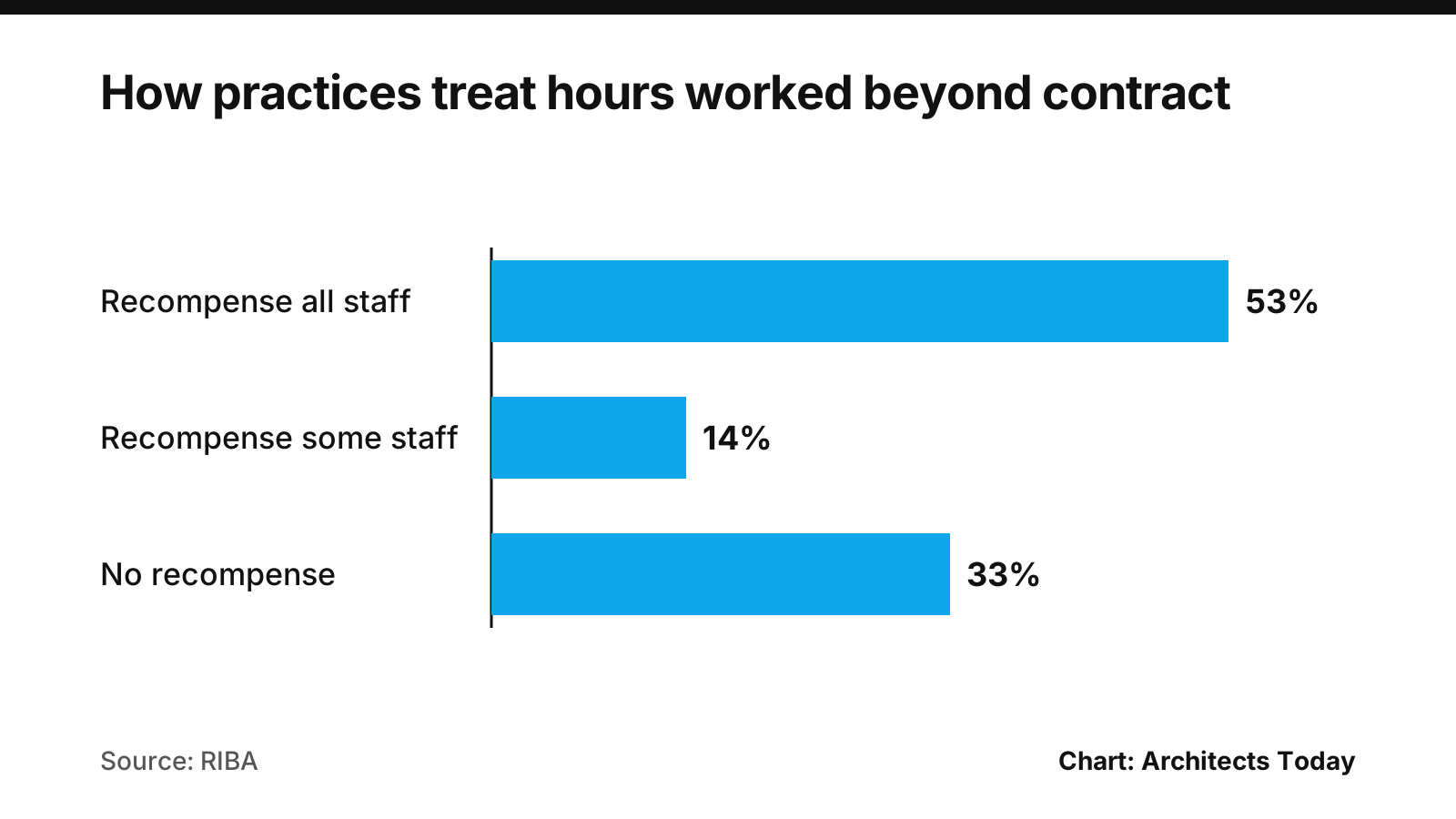
RIBA's Workplace Wellbeing Practice Note, issued on 18 November 2024, warns that unrecompensed overtime can reduce an employee's effective hourly pay below the Real Living Wage, breaching a Chartered Practice's obligations. Adherence to Practice Notes is not compulsory. RIBA survey data cited in the note showed how practices treat hours worked beyond contract:
| Practice approach to extra hours | Share of practices |
|---|---|
| Pay or time off in lieu for all staff | 53% |
| Pay or time off in lieu for some staff | 14% |
| No recompense | 33% |
RIBA encouraged anyone who believes a Chartered Practice is failing to meet its pay obligations to contact its Professional Standards team, and said it has an enforcement process.
New rates
The Living Wage Foundation announced on 15 October 2026 new real Living Wage rates of £14.10 an hour across the UK and £15.45 an hour in London, each a 65p rise. The foundation said nearly 17,000 employers are signed up and that a full-time worker on the new London rate will earn over £5,300 a year more than the government minimum. Chartered Practices had until 1 May 2026 to implement the previous October 2025 rates.
What happens next
RIBA said its Finding and Accessing Architecture expert advisory group will review the Chartered Practice Employment Policy Guide over the next 12 months and look at maternity and paternity arrangements. Further policies and guidance on inclusive recruitment, domestic abuse and allyship are due to be published shortly, it said.
The institute also pointed to its 2025 Build it Together report with the Fawcett Society, which made 47 recommendations for RIBA, practices and government. Of the 20 aimed at RIBA, its one-year action plan addresses 10. Recommendations for practices include full salary transparency, removing contract clauses that stop employees discussing pay, and not asking salary history questions during recruitment.
Sources
- RIBA (opens in a new tab) (accessed 2026-11-05)
- The Pay 100 (opens in a new tab) (accessed 2026-11-05)
- The Pay 100 (opens in a new tab) (accessed 2026-11-05)
- The Pay 100 (opens in a new tab) (accessed 2026-11-05)
- RIBA (opens in a new tab) (accessed 2026-11-05)
- RIBA (opens in a new tab) (accessed 2026-11-05)
- RIBA (opens in a new tab) (accessed 2026-11-05)
- Living Wage Foundation (opens in a new tab) (accessed 2026-11-05)
This story was researched from the primary sources above and checked against them before publication. Spotted an error? Tell us and we will correct it promptly.