planning approvals
TCPA calls for end to permitted development conversions after UCL health study
The Town and Country Planning Association says research led by UCL's Bartlett School of Planning found most residents of office and shop conversions reported quality problems, and wants the national right withdrawn.
The Town and Country Planning Association (TCPA) has called on the government to end permitted development rights for residential conversions, after research led by UCL's Bartlett School of Planning found most residents of converted offices and shops reported problems with their homes.
In a blog published on 12 November, the TCPA said nearly 290,000 people live in housing converted from former office blocks and shops without full planning permission. It described the study as the most comprehensive analysis yet of homes created through permitted development rights (PDR).
The association said the rules, in place since 2013, have allowed offices, shops and other commercial buildings to become homes with councils able to check only a narrow set of issues. Government guidance on GOV.UK describes permitted development rights as a national grant of planning permission.
The findings
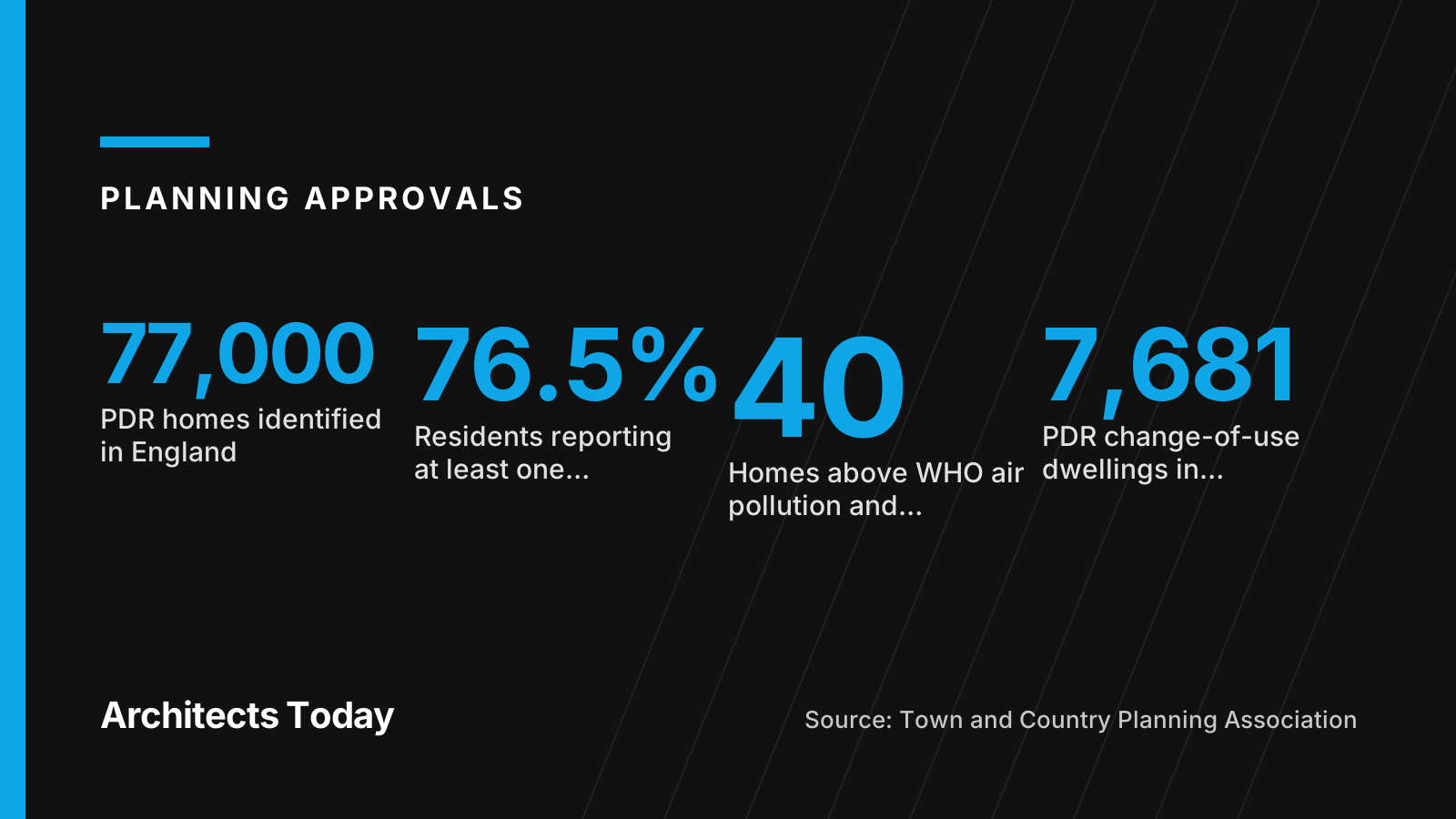
According to the TCPA blog, the researchers identified more than 77,000 PDR homes across England, housing an estimated 289,000 people. Some 85% are former offices. London accounts for nearly a third, at more than 23,000 flats and houses, and Croydon has more than any other local authority in England, at over 3,000.
The TCPA said nearly half of London's PDR homes are within 50 metres of a major road, and almost two fifths nationally sit close to what the research calls "bad neighbours" such as industrial sites, waste facilities and vehicle repair shops. UCL estimates more than 13,000 people in temporary accommodation are placed in PDR housing, the blog said.
The TCPA's resource page for the research says more than 1,000 residents were surveyed. Of those, 76.5% reported at least one problem with the quality of their home, and the blog said over half reported problems in two or more areas.
Monitoring inside homes found air pollution and CO2 levels above World Health Organization guidelines in 40 of 42 homes tested, according to the TCPA. It said 70% of monitored units were underheated in winter, while 45.6% of residents reported overheating in summer. More than one in five residents surveyed showed signs of clinical depression.
In a Bradford case study, the research reported a 49.5% increase in primary care usage among PDR residents compared with before they moved, the TCPA resource page said. The researchers estimated that excess air pollution in converted offices was linked to 5,644 years of life lost and about £413m a year in economic losses across England.
The TCPA's resource page says the research was supported by the National Institute for Health and Care Research (NIHR) and carried out with the London School of Hygiene and Tropical Medicine and the homeless charity Groundswell.
Design quality and building regulations
For architects, the TCPA's criticism centres on what the prior approval process leaves out. The association said councils can assess only a narrow, nationally defined set of issues, which excludes design quality.
It also said loopholes around change of use to residential mean building regulations on matters such as structure, accessibility and overheating do not fully apply to conversions.
The TCPA said it recognised that converting old offices and shops can add to the supply of homes, but argued such conversions must contribute to the place-based policies and design standards set in local plans.
Its resource page says the report calls on the government to remove in its entirety the Town and Country Planning (General Permitted Development) (England) Order 2015, with an adaptive reuse policy in the National Planning Policy Framework in its place. The TCPA also recommended that the government fund a review and, where required, retrofit of existing PDR housing.
The supply context
Government statistics give a measure of what is at stake. According to Ministry of Housing, Communities and Local Government figures, England delivered 208,600 net additional dwellings in 2024-25, a 6% decrease on 2023-24.
Of these, 17,710 came from change of use, including 7,681 through permitted development rights. Within that PDR total, 5,154 dwellings were converted from former offices.
The government previously published commissioned research on the quality of homes delivered through change-of-use permitted development on 21 July 2020, under the then Ministry of Housing, Communities & Local Government.
What happens next
UCL and the TCPA have developed a toolkit to help local authorities use the levers available to them. According to the TCPA event page, it covers resisting PDR conversions where necessary, securing planning gain to manage the quality of conversions, and mitigating harms once buildings are in use.
The toolkit will be discussed in a free webinar for local government on 30 November.
On the record: Ministry of Housing, Communities and Local Government
Sources
- Town and Country Planning Association (opens in a new tab) (accessed 2026-11-12)
- Town and Country Planning Association (opens in a new tab) (accessed 2026-11-12)
- Town and Country Planning Association (opens in a new tab) (accessed 2026-11-12)
- Ministry of Housing, Communities and Local Government (GOV.UK) (opens in a new tab) (accessed 2026-11-12)
- Ministry of Housing, Communities and Local Government (GOV.UK) (opens in a new tab) (accessed 2026-11-12)
- Ministry of Housing, Communities & Local Government (GOV.UK) (opens in a new tab) (accessed 2026-11-12)
This story was researched from the primary sources above and checked against them before publication. Spotted an error? Tell us and we will correct it promptly.